STEP 01 / 12 · 1883
Bonilla’s Procession · Zacatecas, 1883
Hundreds of dark objects crossed the Sun before powered flight
Historical record
In the research record
On August 12 and 13, 1883, José Árbol y Bonilla was observing the Sun from Zacatecas Observatory in Mexico when dark objects began crossing the telescope's field. During three hours and twenty-five minutes of clear observing time spread across the two days, he counted 447 passages. Some objects appeared sharp. Others were surrounded by haze. Bonilla photographed part of the procession and reported it in L'Astronomie in 1886.
Bonilla did not assign the objects a settled cause. An editorial note published with the report suggested birds, insects, or dust passing close to the telescope. In 2011, researchers proposed a very different possibility: fragments of a comet passing close to Earth, with their distance estimated from the difference between what Bonilla saw in Zacatecas and what other observatories did not report. That interpretation remains a preprint hypothesis, not a confirmed reconstruction.
The modern analysis works from the reproduced images and written account published in L'Astronomie. No original plate has been identified in the sources used here. The observation survives. Its distance, scale, and cause do not.
What this adds
Long before satellites or aircraft, an astronomer recorded hundreds of objects crossing the Sun in a few hours. The record contains the count, the drawings, and the photographs. It does not contain an agreed answer.
Status: published historical observation; modern fragmented-comet interpretation at preprint level. Bonilla's report and published reproductions survive. The objects' identity and distance remain unresolved, and the status of any original photographic material has not been established by the sources collected here.
In the novel
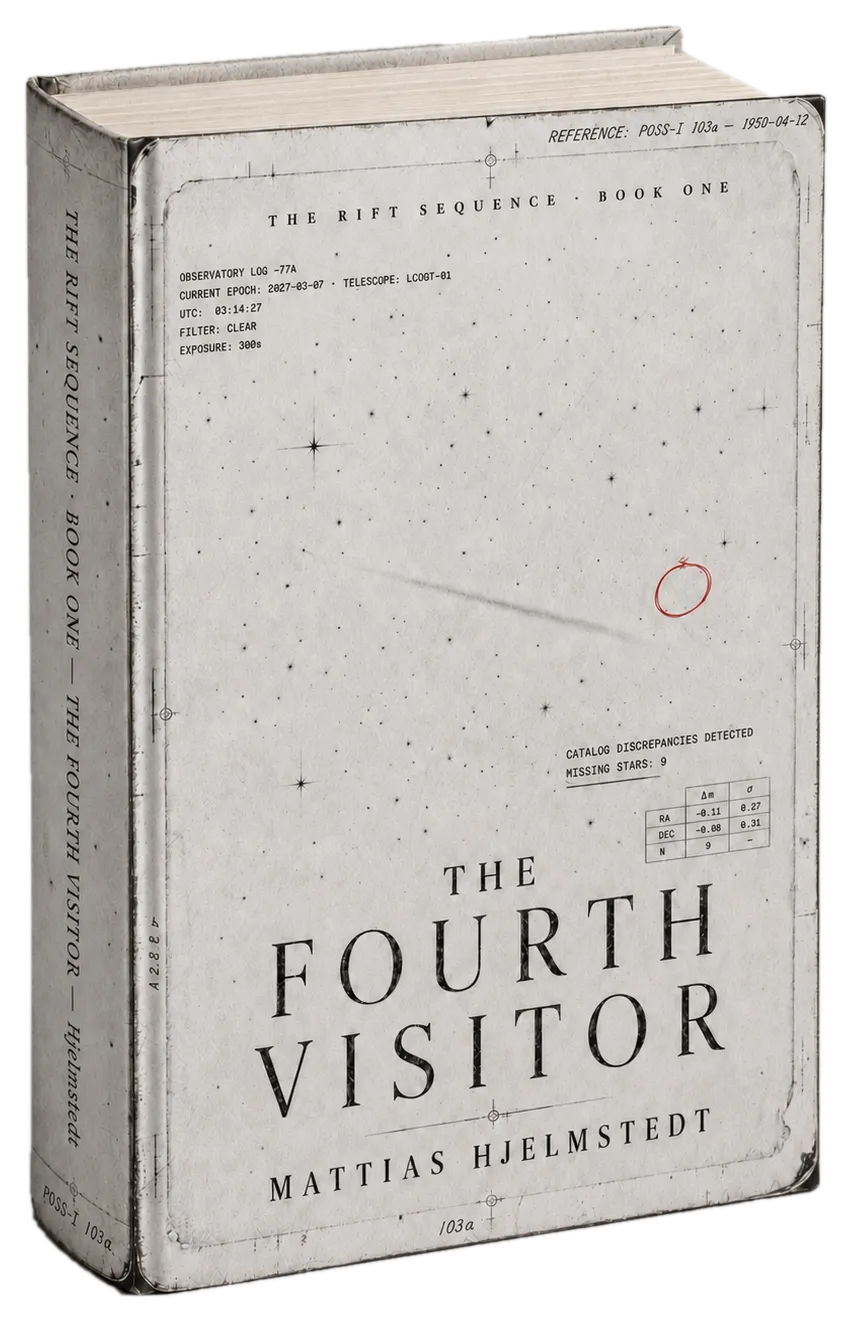
In Chapter 15, Bonilla marks the moment the archive acquires photographs. José Árbol y Bonilla records hundreds of dark objects crossing the Sun in 1883, then publishes the images and observing log three years later. The novel gives the modern fragmented-comet interpretation its full status: a preprint built from surviving reproductions, neither confirmed nor refuted. The physical record enters the lens alongside a proposed natural explanation that is itself an extraordinary near-Earth event.
Sources for this file (2)
Sources · role labels are this entry’s| Source | Status | Role |
|---|
| Árbol y Bonilla, José. “Passage sur le disque solaire d’un essaim de corpuscules, vu à l’observatoire de Zacatecas (Mexique).” L’Astronomie (1 January 1886): 347–350.SOURCE ↗ | Historical record | historical record |
| Durand Manterola, Héctor Javier, María de la Paz Ramos Lara, and Guadalupe Cordero. “Interpretation of the Observations Made in 1883 in Zacatecas (Mexico): A Fragmented Comet That Nearly Hits the Earth.” arXiv:1110.2798 (2011).arXiv:1110.2798 | Preprint | modern interpretation |
The full file →
The photographs survive only as published reproductions. Sixty-seven years later, a wider survey left glass plates detailed enough to be measured again.
STEP 02 / 12 · 1950-04-12
The Nine Transients · Palomar, 1950
Nine points appeared in one exposure. None was recovered at the same positions.
Peer-reviewed finding
In the research record
On April 12, 1950, a fifty-minute red exposure from the first Palomar Observatory Sky Survey recorded nine point-like sources in a small region of the sky. They were not catalogued stars. On another Palomar exposure taken six days later, the same nine sources were absent. A blue exposure of the same field, taken about thirty minutes before the red plate, also shows nothing at their positions. Later digital surveys did not recover convincing counterparts at those positions.
The images available to modern researchers come through a historical reproduction chain. The Palomar survey negatives were copied onto glass for distribution to other observatories, and public digital scans were later made from those copies. That allows the 1950 field to be measured again. It also leaves open the possibility that some marks were introduced when the survey material was copied rather than when the sky was photographed.
If the nine points are astronomical, they represent multiple sources appearing and disappearing inside one exposure window. If they are photographic artifacts, their clustering and shapes must be explained by the plate or copying process. The observation is published. The identity of the nine points is not settled.
What this adds
Nine point-like sources appeared together on one historical exposure and were never recovered at the same positions. The record preserves the event but not its identity.
Status: peer-reviewed finding, actively disputed. The nine detections and their absence at the same positions on later material are documented. Whether they are brief sky events or artifacts introduced within the photographic and copying chain remains unresolved.
In the novel
Chapter 15 places the April 12, 1950 plate at the point where separate archives begin to look like one record. ECE surfaces nine star-like sources present on one fifty-minute POSS-I exposure and absent from a blue exposure half an hour earlier and from the survey's comparison exposure six days later, never recovered since. Their simultaneity, their pre-Sputnik date, and their disappearance become the first hard edge of the archive.
Sources for this file (5)
Sources · role labels are this entry’s| Source | Status | Role |
|---|
| Villarroel, Beatriz, et al. “Exploring Nine Simultaneously Occurring Transients on April 12th 1950.” Scientific Reports 11, 12794 (2021). DOI: 10.1038/s41598-021-92162-7.DOI: 10.1038/s41598-021-92162-7 | Peer-reviewed | finding |
| Hambly, N. C., and A. Blair. “On the Nature of Apparent Transient Sources on the National Geographic Society–Palomar Observatory Sky Survey Glass Copy Plates.” RAS Techniques and Instruments 3 (2024): 73–79. DOI: 10.1093/rasti/rzae004.DOI: 10.1093/rasti/rzae004 | Peer-reviewed | critique |
| Watters, Wesley Andrés, Laura Dominé, Sarah Little, Cameron Pratt, Kevin H. Knuth, and Matthew Szenher. “Critical Evaluation of Studies Alleging Evidence for Technosignatures in the POSS1-E Photographic Plates.” arXiv:2601.21946 (2026).arXiv:2601.21946 | Preprint | critique |
| Villarroel, Beatriz, Alina Streblyanska, Stephen Bruehl, and Stefan Geier. “A Response to Paper ‘Critical Evaluation of Studies Alleging Evidence for Technosignatures in the POSS1-E Photographic Plates’ by Watters et al. (2026).” arXiv:2602.15171 (2026).arXiv:2602.15171 | Preprint | response |
| Hayes, Zachary. “Independent Recovery of Vanishing Sources on POSS-I Photographic Plates Using Automated Source Detection and Cross-Epoch Matching.” arXiv:2604.04810 (2026).arXiv:2604.04810 | Preprint | independent recovery |
The full file →
One plate leaves one set of questions. Two years later, another Palomar exposure carried a different arrangement and the same absence afterward.
STEP 03 / 12 · 1952-07-19
The Triple Transient · Palomar, 1952
Three lights vanished between two photographs of the same sky
Peer-reviewed finding
In the research record
The first Palomar Observatory Sky Survey sometimes photographed the same region more than once. Each glass plate was a long exposure of one patch of sky, so different plates can be placed beside one another like frames separated in time.
On July 19, 1952, one POSS-I exposure recorded three bright, star-like points crowded into a very small area of sky. On the next exposure, taken immediately afterward, all three were gone. Because the first exposure lasted fifty minutes, the plates constrain the disappearance to less than an hour, possibly much faster. Ordinary stars do not switch off together on that timescale.
Enrique Solano, Geoffrey Marcy, Beatriz Villarroel, and their collaborators examined the plates, measured the three images, and checked modern catalogues for anything at the same positions. They published the result in the peer-reviewed Monthly Notices of the Royal Astronomical Society in 2024.
In 2023, the 10.4-meter Gran Telescopio Canarias looked much more deeply at the same location. It found no persistent source at any of the three positions. Anything still there would have to be more than ten thousand times fainter than the points recorded in 1952.
The paper proposes gravitational lensing as one possible natural explanation. In such an event, the gravity of an object passing in front of a more distant source briefly magnifies its light. No lens, repeating event, or remaining source has yet confirmed that explanation.
Roughly nineteen hours after the Palomar exposure, radar operators around Washington, D.C. began recording the first events of the well-documented July 1952 radar episode. The observations were not simultaneous. They occurred on the same American calendar date.
What this adds
Two years after the nine-point plate, a second Palomar sequence recorded a different group of lights disappearing on a timescale the plates themselves could constrain. Modern observation found the same positions empty.
Status: peer-reviewed finding, origin unresolved. Gravitational lensing remains an unconfirmed candidate explanation, and the shared Washington date is a recorded coincidence rather than evidence that the events were connected.
In the novel
In Chapter 15, three bright points on a July 19, 1952 Palomar plate disappear before the next exposure. Their positions remain empty in much deeper imaging seventy-one years later. The novel then places that finding beside the Washington radar events that began roughly nineteen hours later, on the same American calendar date. The timing is not presented as simultaneity or causation. It enters the archive as a coincidence that becomes difficult to forget once both records occupy the same room.
Sources for this file (4)
Sources · role labels are this entry’s| Source | Status | Role |
|---|
| Solano, Enrique, Geoffrey W. Marcy, Beatriz Villarroel, et al. “A Bright Triple Transient That Vanished within 50 Min.” Monthly Notices of the Royal Astronomical Society 527 (2024): 6312–6320. DOI: 10.1093/mnras/stad3422.DOI: 10.1093/mnras/stad3422 | Peer-reviewed | finding |
| United States Air Force. Project Blue Book case files concerning the Washington, D.C., sightings of July 1952. National Archives and Records Administration, Record Group 341.SOURCE ↗ | Historical record | historical record |
| Hambly, N. C., and A. Blair. “On the Nature of Apparent Transient Sources on the National Geographic Society–Palomar Observatory Sky Survey Glass Copy Plates.” RAS Techniques and Instruments 3 (2024): 73–79. DOI: 10.1093/rasti/rzae004.DOI: 10.1093/rasti/rzae004 | Peer-reviewed | critique |
| Watters, Wesley Andrés, Laura Dominé, Sarah Little, Cameron Pratt, Kevin H. Knuth, and Matthew Szenher. “Critical Evaluation of Studies Alleging Evidence for Technosignatures in the POSS1-E Photographic Plates.” arXiv:2601.21946 (2026).arXiv:2601.21946 | Preprint | critique |
The full file →
The date opened a second record in Washington. The years that followed opened a gap in the archive itself.
STEP 04 / 12 · 1953–1968
The Menzel Gap · 1953–1968
Fifteen years in which an observatory stopped recording the sky
Institutional record
In the research record
Harvard College Observatory built one of the longest photographic records of the sky in existence. Then, in 1953, the observing campaign stopped. Harvard's own history describes the suspension as a cost-cutting measure under director Donald Menzel. Plate-taking resumed in the 1960s, leaving the interruption now known as the Menzel Gap.
Dorrit Hoffleit, who worked at the observatory, later wrote that Menzel also ordered part of the plate collection destroyed and that later review limited the loss. That account comes from her memoir and is attributed to her here.
Menzel's other roles are separately documented. During the Second World War he served in the United States Navy on radio propagation, cryptanalysis, and communications work. He later became one of the most prominent scientific writers arguing that reported flying-saucer observations had conventional explanations, including atmospheric effects.
These facts belong to the same biography. The surviving record does not establish that the plate interruption, the destruction account, the military work, and the public UFO arguments were parts of one coordinated act.
What this adds
One of the world's longest photographic records of the sky contains a gap created by an institutional decision. The man responsible for that decision also occupied other roles that make the gap difficult to encounter as a neutral absence, even though the record does not prove a hidden cause.
Status: documented institutional history with one attributed memoir account. Harvard documents the suspension and its financial rationale. Menzel's military work and public UFO writing are independently documented. The plate-destruction account is Hoffleit's. No causal relationship among those facts is established by the record.
In the novel
In Chapter 15, ECE does not accuse Donald Menzel of causing the gap it finds. It places documented facts side by side: he led Harvard College Observatory when its plate-taking program stopped; Dorrit Hoffleit wrote that he ordered part of the collection destroyed; later committees approved further destruction; he did military work; and he became a prominent public advocate of natural explanations for UAP reports. The chief supplies the suspicion. Amina keeps it out of the finding. The tension comes from the record without requiring the novel to settle why the decisions were made.
Sources for this file (6)
Sources · role labels are this entry’s| Source | Status | Role |
|---|
| Harvard College Observatory, Center for Astrophysics | Harvard & Smithsonian. Institutional history of the observatory and its photographic-plate programme.SOURCE ↗ | Institutional | institutional history |
| Wolbach Library, Center for Astrophysics. Plate Stacks collection history and digitization timeline. | Institutional | institutional timeline |
| Hoffleit, Dorrit. Misfortunes as Blessings in Disguise: The Story of My Life. American Association of Variable Star Observers, 2002.SOURCE ↗ | Book | memoir |
| Goldberg, Leo, and Lawrence H. Aller. “Donald Howard Menzel.” In Biographical Memoirs, Vol. 60. National Academy of Sciences, 1991. DOI: 10.17226/6061.DOI: 10.17226/6061 | Historical record | biographical source |
| Bauer, Craig, and John Ulrich. “The Cryptologic Contributions of Dr. Donald Menzel.” Cryptologia 30, no. 4 (2006): 306–339. DOI: 10.1080/01611190600920951.DOI: 10.1080/01611190600920951 | Peer-reviewed | research history |
| Menzel, Donald H. Flying Saucers. Harvard University Press, 1953.SOURCE ↗ | Book | primary published position |
The full file →
The missing plates cannot be recovered. The plates that survive can still be asked a physical question.
STEP 05 / 12 · 1949–1957 plates · analyzed 2022–2026
The Earth-Shadow Deficit · POSS-I plates, 1949–1957
A reported reflected-light pattern at satellite altitude before satellites
Peer-reviewed finding
In the research record
Before Sputnik, astronomers surveyed the sky by exposing large photographic plates through telescopes. Each exposure preserved the positions of stars and any brief points of light bright enough to register during those minutes. The Palomar survey originals were also reproduced as glass copy sets for use at other observatories. Modern catalogues used in this research were built from digitized scans of those copies. That preserved the sky well enough to measure it again, but the copying process also created one of the central artifact questions in the dispute.
A star produces its own light. It does not disappear because Earth's shadow falls across nearby space. An object seen because it reflects sunlight is different. If Earth moves between that object and the Sun, sunlight no longer reaches it, so its reflection should disappear from the photograph.
Researchers took transient candidates from the first Palomar Observatory Sky Survey and calculated where Earth's shadow would have crossed each photographed field if the sources were at different distances from Earth. This was not a distance measurement of any individual flash. It was a population test: at what assumed distance, if any, did the recorded flashes become rarer inside the calculated shadow?
The strongest reported deficit appeared at geosynchronous distance. Far fewer candidates were found where Earth's shadow would have blocked sunlight from objects in that region of space. The tested orbit has a radius of 42,164 kilometers from Earth's center, approximately 35,786 kilometers above the surface.
That gives the observation physical meaning. If the candidate flashes are real sky events, the distribution behaves as reflected light should behave near the altitude now occupied by geosynchronous satellites. The analysis does not show what produced the reflections, and it does not measure the distance to any individual source.
What this adds
Before satellites, the reported flashes became rarer exactly where Earth would have blocked sunlight from reflective objects at the altitude where geosynchronous satellites now orbit.
Status: peer-reviewed finding, actively disputed. The originating analysis reports a strong population deficit in the calculated Earth-shadow region. A later critique argues that the result does not survive its strictest candidate-vetting choices; the authors' response retains the result under a different plate-selection treatment. The disagreement remains unresolved.
In the novel
In Chapter 15, the shadow deficit changes the archive from testimony into geometry. If the transient candidates were reflections from objects near geosynchronous altitude, fewer should appear where Earth blocks the sunlight, and that is the distribution the originating analysis reports. The team is careful about what follows: the altitude is inferred from the assumed shadow geometry, not measured by parallax, and the result survives only if the candidates are real flashes. The novel keeps the dispute in the room because the disagreement is not over what a shadow would mean. It is over which points belong in the count.
Sources for this file (5)
Sources · role labels are this entry’s| Source | Status | Role |
|---|
| Villarroel, Beatriz, et al. “Aligned, Multiple-transient Events in the First Palomar Sky Survey.” Publications of the Astronomical Society of the Pacific 137, 104504 (2025). DOI: 10.1088/1538-3873/ae0afe.DOI: 10.1088/1538-3873/ae0afe | Peer-reviewed | finding |
| Doherty, Brian. “Independent Replication of Nuclear Test-Transient Correlations and Earth Shadow Deficit in POSS-I Photographic Plates.” arXiv:2604.00056 (2026).arXiv:2604.00056 | Preprint | independent reanalysis |
| Watters, Wesley Andrés, Laura Dominé, Sarah Little, Cameron Pratt, Kevin H. Knuth, and Matthew Szenher. “Critical Evaluation of Studies Alleging Evidence for Technosignatures in the POSS1-E Photographic Plates.” arXiv:2601.21946 (2026).arXiv:2601.21946 | Preprint | critique |
| Villarroel, Beatriz, Alina Streblyanska, Stephen Bruehl, and Stefan Geier. “A Response to Paper ‘Critical Evaluation of Studies Alleging Evidence for Technosignatures in the POSS1-E Photographic Plates’ by Watters et al. (2026).” arXiv:2602.15171 (2026).arXiv:2602.15171 | Preprint | response |
| Bruehl, Stephen, and Beatriz Villarroel. “Transients in the Palomar Observatory Sky Survey (POSS-I) May Be Associated with Nuclear Testing and Reports of Unidentified Anomalous Phenomena.” Scientific Reports 15, 34125 (2025). DOI: 10.1038/s41598-025-21620-3.DOI: 10.1038/s41598-025-21620-3 | Peer-reviewed | context |
The full file →
The geometry points toward an altitude. Then, in 1957, humanity began placing its own objects in the same sky.
STEP 06 / 12 · 1957
1957 · The Channel Break
The year humanity began adding its own reflections to the sky
Historical record
In the research record
Before satellites, a brief reflection high above Earth was an unusual kind of observation. After satellites, human-made objects began producing flashes of sunlight in the same region of space.
That does not mean continuous space observation began in 1957. It means the channel changed. The category of light being examined was no longer free of objects humanity had placed there itself.
The observing record changed at the same time. The first Palomar Observatory Sky Survey ended in April 1957. Sputnik launched in October. Harvard had already stopped taking plates in 1953 and would not resume until 1968. Later programs used different telescopes, photographic emulsions, parts of the sky, exposure lengths, and observing schedules.
This prevents a clean before-and-after experiment. Researchers do not have one unchanged instrument watching the same sky in the same way across the satellite boundary. A lower density of the earlier signature after 1957 could mean that a physical population changed. It could also mean that the instruments changed, the coverage changed, and human satellite glints began filling the same observational category.
The factual boundary is therefore stronger than either interpretation. POSS-I closed, the satellite era began, and the optical channel became different. The existing record cannot determine whether the earlier source population withdrew or whether its signal became harder to distinguish from our own reflections.
What this adds
The pattern does not end with a clean disappearance. It reaches the moment when humanity entered the same observational space and made the older signal harder to read.
Status: established observational boundary, physical interpretation open. The instruments and channel changed across 1957; the record cannot currently distinguish a source-population decline from the loss of a clean observing channel.
In the novel
Chapter 15 ends the plate sequence at 1957 because the observational channel changes there. POSS-I closes in April. Sputnik launches in October. Human-made glints begin entering the same class of observation, plate programs and emulsions change, and Harvard's own coverage is already interrupted. ECE finds the earlier signature declining across that boundary but cannot tell whether a physical population withdrew or whether the signal became indistinguishable from a sky filling with new reflections. The novel preserves both readings. The ambiguity is the hinge, not a problem to be edited away.
Sources for this file (3)
Sources · role labels are this entry’s| Source | Status | Role |
|---|
| Hoffleit, Dorrit. Misfortunes as Blessings in Disguise: The Story of My Life. American Association of Variable Star Observers, 2002.SOURCE ↗ | Book | context |
| Villarroel, Beatriz, et al. “The Vanishing and Appearing Sources during a Century of Observations Project. I. USNO Objects Missing in Modern Sky Surveys and Follow-up Observations of a ‘Missing Star.’” The Astronomical Journal 159, 8 (2020). DOI: 10.3847/1538-3881/ab570f.DOI: 10.3847/1538-3881/ab570f | Peer-reviewed | context |
| DASCH, Digital Access to a Sky Century at Harvard. Harvard College Observatory photographic-plate digitization project.SOURCE ↗ | Institutional | archive |
The full file →
The optical record became harder to separate. Other instruments began listening for a different kind of evidence.
STEP 07 / 12 · 1977-08-15
The Wow! Signal · August 15, 1977
For seventy-two seconds, a radio telescope recorded something that never returned
Historical record
In the research record
Ohio State University's Big Ear was a stationary radio telescope. It did not track a target across the sky. Instead, Earth's rotation carried each part of the sky through the telescope's narrow listening beam.
That created a built-in test. A signal from a fixed position in the sky should gradually strengthen as the source entered the beam, peak near the center, and weaken as it moved out again. The complete passage would take seventy-two seconds.
On August 15, 1977, during a search for possible extraterrestrial radio signals, Big Ear recorded a powerful signal concentrated in a very narrow range of frequencies. That means most of its radio energy arrived inside one small part of the spectrum, the kind of concentrated signal SETI surveys were designed to notice. It rose and fell across the full seventy-two seconds in the shape expected from something fixed in the sky.
The telescope's computer encoded the changing strength as the characters 6EQUJ5. The sequence was not a message. It was a compact way of printing six successive intensity measurements. When astronomer Jerry Ehman later reviewed the paper output, he circled the sequence and wrote "Wow!" beside it.
The telescope's observing method made the event look consistent with a source passing through its beam. But the signal was never detected again. Without a second observation, astronomers could not refine its position, compare its behavior, or test an explanation against a repeat.
Proposals have included terrestrial interference, reflected human transmissions, and natural emission associated with hydrogen. None has become a generally accepted identification of the original signal.
What this adds
The record contains more than a dramatic printout. The signal changed strength exactly as the telescope's geometry said a fixed sky source should, then denied every later attempt to observe it again.
Status: documented signal, origin unresolved. The detection was never repeated, leaving proposed terrestrial and natural explanations without a confirming second observation.
In the novel
Chapter 15 places the Wow! signal in an annex of cases astronomy took seriously without endorsing. A narrowband radio signal lasted for the full seventy-two seconds that the Big Ear telescope could observe a fixed point as Earth rotated. Jerry Ehman circled the intensity code on the printout and wrote one word beside it. The signal sits outside the novel's statistical chain. The silence afterward carries the case: it was never recovered, and no second observation arrived to decide what the first one meant.
Sources for this file (2)
Sources · role labels are this entry’s| Source | Status | Role |
|---|
| Ehman, Jerry R. Big Ear Radio Observatory computer printout and handwritten annotation for the Wow! signal, 15 August 1977.SOURCE ↗ | Historical record | historical record |
| Enriquez, J. Emilio, et al. “The Breakthrough Listen Search for Intelligent Life: 1.1–1.9 GHz Observations of 692 Nearby Stars.” The Astrophysical Journal 849, 104 (2017).SOURCE ↗ | Peer-reviewed | context |
The full file →
The signal never returned. Thirteen years later, a national air force recorded an event across another instrument stack.
STEP 08 / 12 · 1990-03-30/31
Belgium · Ground and F-16 radar, March 1990
A national air force recorded an event it could not classify
Institutional record
In the research record
Radar works by sending out radio energy and measuring what returns. The timing and direction of the echo can indicate that something is present and moving, but radar does not automatically reveal what produced the return. Aircraft, weather, the way radio waves bend through the atmosphere, equipment behavior, and processing can all affect what an operator sees.
On the night of March 30 to 31, 1990, Belgian ground radar registered unusual contacts during a wider period of public reports. Controllers directed two F-16 fighters to investigate. The aircraft obtained intermittent radar locks of their own, but the pilots did not visually identify a corresponding craft.
That distinction matters. The event was not merely an eyewitness report. Ground systems and aircraft systems produced an instrument record. But the different observations did not resolve into an identified object that could be inspected afterward.
The Belgian Air Force did something unusual with the uncertainty. Colonel Wilfried De Brouwer presented its account and radar traces publicly, and a military technical report by Lieutenant Colonel Salmon examined the recordings. The Air Force documented the interception without claiming that it had established what the target was.
The episode occurred within the larger Belgian wave of reports that began in November 1989. A famous photograph associated with that wave was later admitted to be a hoax. That photograph is not the source of the March radar record.
What this adds
The archive moves from photographs to a modern operational system: ground controllers, fighter aircraft, onboard radar, recorded data, and an institution willing to release the event without supplying a final answer.
Status: institutional record, target classification unresolved. The interception and radar recordings are documented; the interpretation of the returns remains disputed, and the later hoaxed photograph is not part of the radar record.
In the novel
In Chapter 15, the Belgian case enters through the Heuristic Engine's compressed register: radar lock recorded, target classification unresolved, interpretation disputed. The chief then walks the team through the institutional response. Ground radar and F-16 systems registered an event; the pilots did not obtain visual confirmation; the Belgian Air Force released the record rather than claiming a solution. The novel uses the case not as proof of a craft, but as an example of a modern state treating an unexplained instrument record as an operational fact without pretending it knew what had produced it.
Sources for this file (2)
Sources · role labels are this entry’s| Source | Status | Role |
|---|
| Belgian Air Force. Radar trace charts and public briefing concerning the F-16 interception of 30–31 March 1990. Presented by Col. Wilfried De Brouwer, 11 July 1990. | Institutional | historical record |
| Belgian Air Force. Rapport du Lt. Colonel Salmon au sujet des échos radar enregistrés lors d’un vol de F-16 belges au cours de la nuit du 30 au 31 mars 1990. 1990; released by the Belgian Ministry of Defence, 18 June 2025, reference SAT7–OBPA 04/25. | Institutional | technical analysis |
The full file →
Radar could not settle what moved through Belgian airspace. In 2017, the uncertainty arrived from outside the Solar System.
STEP 09 / 12 · 2017
ʻOumuamua · Non-gravitational acceleration, 2017
The first known interstellar visitor did not follow a purely gravitational path
Peer-reviewed finding
In the research record
ʻOumuamua was discovered in October 2017 after it had passed closest to the Sun. Its speed and path showed that it was not bound to the Sun. It had entered from interstellar space and would leave again. Astronomers followed it by repeatedly measuring its position against the background stars. Gravity predicts where an object should appear next. ʻOumuamua did not remain exactly on that predicted path. As it moved away from the Sun, it received a small additional push directed outward.
Comets often receive this kind of push when sunlight heats their ice. Escaping gas acts like a weak jet and alters the orbit. Usually that process also produces a visible coma, the cloud of gas and dust surrounding an active comet.
No resolved coma or ordinary outgassing signature was detected around ʻOumuamua. Marco Micheli and collaborators nevertheless found that a comet-like non-gravitational force provided the best fit to the measured trajectory. They published the acceleration in the peer-reviewed journal Nature in 2018.
The acceleration is measured. Its cause is not. Researchers have proposed several natural mechanisms, including unusual volatile ices and forms of outgassing that would have been difficult to detect. Shmuel Bialy and Avi Loeb proposed that sunlight itself could push an extremely thin object through radiation pressure, opening the artificial-sail interpretation.
No telescope resolved ʻOumuamua into an image. Its shape, composition, and the mechanism behind the acceleration are reconstructed from limited light and motion data rather than seen directly.
What this adds
The first object ever confirmed to have arrived from another star did not fit cleanly into the categories available when it was found. The unexplained part is not that it came from interstellar space. It is what supplied the additional push.
Status: peer-reviewed observation, interpretation unresolved. The acceleration is measured; the outgassing, volatile-fragment, and radiation-pressure models are competing explanations for its cause.
In the novel
Chapter 14 asks the team to read ʻOumuamua again after they have the Fourth as a physical reference. The observed fact remains the same: the first known interstellar object showed a small, sustained outward acceleration without the visible gas or dust normally expected to provide the thrust. The novel places that acceleration beside a measured behavior of the Fourth, then lets similarity acquire weight that the real-world observation cannot carry alone.
Sources for this file (4)
Sources · role labels are this entry’s| Source | Status | Role |
|---|
| Meech, Karen J., et al. “A Brief Visit from a Red and Extremely Elongated Interstellar Asteroid.” Nature 552 (2017): 378–381.SOURCE ↗ | Peer-reviewed | finding |
| Micheli, Marco, et al. “Non-gravitational Acceleration in the Trajectory of 1I/2017 U1 (ʻOumuamua).” Nature 559 (2018): 223–226.SOURCE ↗ | Peer-reviewed | finding |
| Bialy, Shmuel, and Abraham Loeb. “Could Solar Radiation Pressure Explain ʻOumuamua’s Peculiar Acceleration?” The Astrophysical Journal Letters 868, L1 (2018).SOURCE ↗ | Peer-reviewed | interpretation |
| International Astronomical Union Minor Planet Center. Minor Planet Electronic Circulars and designation records for 1I/ʻOumuamua, 2I/Borisov, and 3I/ATLAS.SOURCE ↗ | Institutional | catalogue |
The full file →
The first visitor accelerated without the visible activity expected. The third arrived with chemistry that made a different kind of anomaly.
STEP 10 / 12 · 2025
3I/ATLAS chemistry · One pre-perihelion epoch, 2025
The third interstellar visitor released far more carbon dioxide than water
Peer-reviewed finding
In the research record
3I/ATLAS is the third object confirmed to have entered the Solar System from interstellar space. Unlike ʻOumuamua, it developed a clearly active coma as sunlight heated its surface and released frozen material.
Scientists can identify the gases in a coma without collecting them. A spectrograph separates the object's light into wavelengths. Different molecules leave different infrared fingerprints, allowing researchers to estimate how much of each gas the comet is releasing.
Before ATLAS reached its closest point to the Sun, the James Webb Space Telescope measured an exceptionally carbon-dioxide-rich state. At that observing epoch, the coma was producing about 7.6 units of carbon dioxide for every unit of water. That was among the highest carbon-dioxide-to-water ratios reported for a comet.
Martin Cordiner and collaborators published the measurement in the peer-reviewed Astrophysical Journal Letters. Later observations, including additional work with JWST, found different mixtures of gas as ATLAS travelled through the Solar System. The ratio did not remain fixed.
The initial measurement was therefore not the object's permanent composition. It was a real state observed at a particular time. That changing chemistry also carries information: different ices can begin escaping as sunlight reaches new layers, so the evolution may reflect where the object formed, how it was altered before arrival, and how heat moved through it during passage.
What this adds
ATLAS did not merely contain an unusual amount of carbon dioxide. Its chemistry changed as the Sun reached different material, giving researchers a moving view into an object formed around another star.
Status: peer-reviewed, evolving compositional finding. The unusually carbon-dioxide-rich epoch is established; the ratio changed across the passage and must not be presented as a permanent composition.
In the novel
In Chapter 14, the team uses a specific pre-perihelion epoch, when JWST measured an exceptionally carbon-dioxide-rich coma, and compares that ratio with the Fourth's shell material under equivalent heating. Later observations show the ratio changing as the coma evolves, and that evolution remains in the finding. The novel's weight comes from the laboratory match to one observed state rather than from a fixed composition assigned to the entire passage.
Sources for this file (4)
Sources · role labels are this entry’s| Source | Status | Role |
|---|
| Seligman, Darryl Z., et al. “Discovery and Preliminary Characterization of a Third Interstellar Object: 3I/ATLAS.” arXiv:2507.02757 (2025). Accepted for publication in The Astrophysical Journal Letters.arXiv:2507.02757 | Preprint | finding |
| Cordiner, Martin A., et al. “JWST Detection of a Carbon Dioxide Dominated Gas Coma Surrounding Interstellar Object 3I/ATLAS.” The Astrophysical Journal Letters (2025). DOI: 10.3847/2041-8213/ae0647.DOI: 10.3847/2041-8213/ae0647 | Peer-reviewed | finding |
| Belyakov, Matthew, et al. “The Volatile Inventory of 3I/ATLAS as Seen with JWST/MIRI.” The Astrophysical Journal Letters 1001, L11 (2026). DOI: 10.3847/2041-8213/ae5700.DOI: 10.3847/2041-8213/ae5700 | Peer-reviewed | finding |
| Keto, Eric, and Abraham Loeb. “A Physical Model for the Ice Coma of the Interstellar, Hyperactive Comet 3I/ATLAS.” arXiv:2510.18157 (2025).arXiv:2510.18157 | Preprint | natural model |
The full file →
The volatile ratio changed across the passage. The metal lines changed too, and not together.
STEP 11 / 12 · 2021–2025
Low-temperature metal chemistry · 3I/ATLAS
Metal entered the gas around cold comets by a route still being worked out
Peer-reviewed finding
In the research record
Metals are not expected to evaporate easily from a cold comet. Yet in 2021, two papers in Nature reported neutral iron and nickel atoms in cometary atmospheres far from the Sun. One survey found both metals in Solar System comets. The other found gaseous nickel in the coma of the interstellar comet 2I/Borisov at a temperature where ordinary metal grains should remain solid.
The third interstellar object sharpened the problem. Early observations of 3I/ATLAS detected numerous nickel lines while iron remained undetected. As the comet moved closer to the Sun and then beyond perihelion, iron appeared and the nickel-to-iron ratio moved toward values seen in Solar System comets. The anomaly was therefore not a permanent absence of iron. It was an evolving release sequence in which nickel entered the coma first and much more efficiently.
The leading natural explanations involve compounds or grains that can release metal at far lower temperatures than metallic material itself. Nickel carbonyl is one candidate because it is more volatile than the corresponding iron compound. Later modelling found that carbonyl sublimation can reproduce much of the observed nickel and iron evolution, possibly with an additional temporary heat source inside the comet. The carrier has not been captured and identified directly.
The observation is no longer “nickel with no natural mechanism.” It is a measured chemical sequence with plausible natural routes whose physical source inside the comet remains under investigation.
What this adds
Across two interstellar comets, metal appeared in gas at temperatures where simple metal sublimation should not work. In 3I/ATLAS, nickel arrived first and iron followed later. The sequence has possible natural explanations, but it remains a real chemical constraint any explanation must satisfy.
Status: peer-reviewed observational foundation with a developing 3I/ATLAS interpretation. Cold gas-phase metal in cometary comae is established. The early nickel excess and later iron recovery in 3I/ATLAS are observed. Carbonyl and low-energy dust-release models provide natural explanations, but the responsible carrier has not been measured directly.
In the novel
Chapter 14 isolates the anomaly precisely: nickel was detected during ATLAS epochs when corresponding iron was not, with iron appearing later. Ethan explains why that matters by pointing to metal-carbonyl chemistry, including the Mond process used on Earth to carry nickel selectively at low temperatures. The novel then adds its fictional reference object: fragments of the Fourth reproduce the release pattern in controlled heating. The published record supplies the cold-nickel puzzle. The material match is what lets the story's team place it inside a larger engineered-chemistry lens.
Sources for this file (4)
Sources · role labels are this entry’s| Source | Status | Role |
|---|
| Manfroid, Jean, Damien Hutsemékers, and Emmanuel Jehin. “Iron and Nickel Atoms in Cometary Atmospheres Even Far from the Sun.” Nature 593 (2021): 372–374. DOI: 10.1038/s41586-021-03435-0.DOI: 10.1038/s41586-021-03435-0 | Peer-reviewed | finding |
| Guzik, Piotr, and Michał Drahus. “Gaseous Atomic Nickel in the Coma of Interstellar Comet 2I/Borisov.” Nature 593 (2021): 375–378. DOI: 10.1038/s41586-021-03485-4.DOI: 10.1038/s41586-021-03485-4 | Peer-reviewed | finding |
| Rahatgaonkar, Rohan, et al. “Very Large Telescope Observations of Interstellar Comet 3I/ATLAS. II. From Quiescence to Glow: Dramatic Rise of Ni I Emission and Incipient CN Outgassing at Large Heliocentric Distances.” The Astrophysical Journal Letters 995, L34 (2025). DOI: 10.3847/2041-8213/ae1cbc.DOI: 10.3847/2041-8213/ae1cbc | Peer-reviewed | 3I/ATLAS finding |
| Hutsemékers, Damien, et al. “Origin and Evolution of Ni I and Fe I in the Coma of the Interstellar Comet 3I/ATLAS Throughout Its Trajectory.” arXiv:2605.07652 (2026).arXiv:2605.07652 | Preprint | evolution and interpretation |
The full file →
Cold nickel asks what chemistry can carry. The older plates ask whether their transient population responded to an environment.
STEP 12 / 12 · 2026
The geomagnetic dose-response · 2026 analysis
The old flashes changed with the weather in space
Preprint analysis
In the research record
Geomagnetic storms begin when activity from the Sun disturbs Earth's magnetic field and the charged-particle environment surrounding the planet. The Kp index expresses the strength of that disturbance on a scale running from quiet conditions to the most severe storms.
The transient candidates were points found on one historical photograph but absent from later surveys. Some may be brief flashes from the sky, while others may be defects in the photographic material.
Kevin Cann took the dates and times of Palomar plates containing those candidates and compared them with the geomagnetic conditions during each exposure. He divided the observations into five levels of storm activity and asked whether the rate of transient detections changed as the storms became stronger.
It did. Transients appeared on 17.4 percent of the examined plates during quiet conditions. At the strongest level of geomagnetic activity, they appeared on 2.4 percent. The decline occurred step by step across the five storm levels rather than appearing only at one arbitrary dividing line.
Cann then examined what happened after storms ended. Detection rates briefly rose above their normal level before settling back toward the usual background. He reported the decline, rebound, and recovery in a 2026 preprint series.
There was an obvious alternative explanation. Geomagnetic storms can change airglow in Earth's upper atmosphere. Perhaps the sky became brighter, the photographic plates recorded less detail, and faint marks were simply harder to detect.
A separate control analysis tested that possibility using plates from Harvard and Palomar. It found no matching decline in the faintest light the plates could record. The plates did not become less sensitive in step with the storms.
A random scratch in photographic emulsion has no physical reason to know whether Earth's magnetic environment is quiet or disturbed. A population of material inside that environment could respond. The same research proposes charged dust interacting with plasma near geosynchronous altitude as a natural explanation.
That natural model changes what the sources might be. It does not remove the reported connection between the transient population, space weather, and the region where modern satellites orbit.
What this adds
The Earth-shadow finding points toward satellite altitude through reflected sunlight. The storm response points toward the same region through a different physical effect. Both patterns were reported in photographic observations made before human satellites occupied that space.
Status: preprint finding, candidate foundation disputed. The dose-response and plate-sensitivity control have not been directly rebutted, but they operate on a transient population whose candidate vetting is contested.
In the novel
Chapter 15 treats the storm result as evidence that cuts both ways. The transient detection rate falls step by step as geomagnetic activity rises, rebounds after storms, and returns toward baseline. A plate-sensitivity control does not show the same response. To the team, that makes random scratches difficult to reconcile with the pattern and adds a second physical route toward the geosynchronous environment. In the same breath, the chapter gives the published natural candidate: charged dust trapped in disturbed plasma. The finding strengthens the phenomenon while reopening what the phenomenon might be.
Sources for this file (4)
Sources · role labels are this entry’s| Source | Status | Role |
|---|
| Cann, Kevin. “Geomagnetic Storm Suppression of Photographic Plate Transient Detections in the POSS-I Archive: An Independent Physical Variable Strengthening the Nuclear Test Correlation.” arXiv:2604.04950 (2026).arXiv:2604.04950 | Preprint | finding |
| Cann, Kevin. “Storm-Driven Suppression and Post-Storm Enhancement of Photographic Plate Transient Detections at Geosynchronous Altitude: Empirical Evidence and a Candidate Dusty Plasma Mechanism.” arXiv:2604.06234 (2026).arXiv:2604.06234 | Preprint | natural alternative |
| Cann, Kevin. “Plate Sensitivity Is Invariant Across Geomagnetic Storm Intensity at Harvard and Palomar: A Protocol for Artifact Control in Historical Plate Archive Studies.” arXiv:2604.16470 (2026).arXiv:2604.16470 | Preprint | artifact control |
| Bruehl, Stephen, and Beatriz Villarroel. “Transients in the Palomar Observatory Sky Survey (POSS-I) May Be Associated with Nuclear Testing and Reports of Unidentified Anomalous Phenomena.” Scientific Reports 15, 34125 (2025). DOI: 10.1038/s41598-025-21620-3.DOI: 10.1038/s41598-025-21620-3 | Peer-reviewed | context |
The full file →